Tuesday, January 10, 2012

Cumbria, Sheffield, Mormon History. Mormon Convert Immigration 19th C. Coming to America

Mormon History
Convert Immigration from England
19th Century
Perpetual Emigrating Fund
.

Mormonism.  Converts. History. The fast rise of a religion. Here, the impact on historical interest triggered by a Mormon candidate for the presidency of the United States/

1.  Roots of Mitt Romney.  Cumbria.  Dalton?

The current American presidential election process includes a Mormon candidate, whose forbears are traced, apparently, to 1837 or so, to Cumbria, Dalton in particular, see  http://www.in-cumbria.com/white-house-hopeful-s-connection-to-furness-1.908148?referrerPath=news-archive.  This is an area that includes the Appleby Horse Fair, held 2011 on June 3-5.  This event attracts thousands of people of Traveler, Gypsy heritage, see http://www.applebyfair.org/
.
Interest simmers, not a big deal, on the ethnic roots of the candidate:  Mitt Romney, with Romneys in England for several centuries.  And in the process of Mormon conversions and financial support for converts.  See http://martinlutherstove.blogspot.com/#!/2012/01/mormon-converts-19th-c-owned-by-company.html.
.
With a name, Romney, so like Roma, Rom, Romany, we looked around. 
.
2.  Are there roots in Romney Marsh of Kent.

And, the closest connection for Romney with Romany or Roma or Rom (Travelers, Gypsies) is in the Romney Marsh of Kent.  This is specifically stated also as the Romany Marsh, see http://www.infobarrel.com/History_of_Romney_Marsh_kent.  A smugglers' haven -- wool, brandy, tea. Special breed of sheep that do well in the wet. The identification by surname and ethnic name is tenuous to be sure, and certainly in the dimmer past, but not so far fetched.  Will our Mitt Romney take an interest, ever, in migration, ethnic groups, and their opportunities.
.
3.  The rise of Mormonism

Mormonism, properly known as Jesus Christ Church of Latter Day Saints, or LDS, began formally in America in 1830 by a previously unknown person, one Joseph Smith.

The religious sytem rapidly spread by means of LDS missionaries abroad, particularly in England. This activity resulted in a large migration of newly converted believers, thousands from the mainly industrial cities and worker neighborhoods (is that so?). These new Mormons emigrated to harbor areas in America from Boston to Louisiana, and then to gathering points to Utah by wagon train, see the BBC overview of basic beliefs at  http://www.bbc.co.uk/religion/religions/mormon/ataglance/glance.shtml.

Our candidate's family in Dalton was apparently converted in 1837. Who were they, to take on something so new? Are there any birth or death records prior to 1837, land holdings.  Or were they, as so many of our own forbears, not within the established cultural system.

Dalton is eager to claim Mitt Romney, see http://www.daltonlocal.co.uk/us-republican-politician-mitt-romney-s-dalton-heritage-goes-back-to-1642-1.907821?referrerPath=home.  See all the connections with family that that site lays out, tourists ho. An interest remains in photos, birth records, gravesites, documentation, of Church of England or Roman Catholic heritage, or other mainstream British Christian.  This documentation of Romney heritage would offset the clear suggestion that, at some point, a Romani family assimilated. All we need are the documents, the vetting.

The BBC identifies working class British as the primary converts, as industrial conditions were so harsh on laboring people. And there were also the poor, no resources. The BBC identifies Sheffield in particular as a human tragedy, for whom an alternative, a religion that welcomed them and would help them get to America, was a magnet.  See "social misery" at http://www.bbc.co.uk/legacies/immig_emig/england/south_yorkshire/article_1.shtml

4.  Financial help to converts.

Cash offered help to the poor and middling in their conversion.  The Mormons' Perpetual Emigration Fund or Perpetual Emigrating Fund, see Google Book Journal of Discourses of Brigham Young1854, on the establishment of it: reasons, methods.

The Perpetual Emigration Fund, or PEF, accordingly, was set up as a corporation by the Mormons in 1849, by which converts got free passage to America in exchange for repaying the amount (how much? was there interest? were fortunes made on a profit between passage costs and amount charged) -- a kind of indentured servitude a the American end? Or a huge student loan idea -- could the people get out of it if they changed heir minds?  In either event, it was a helping hand, get people over here, get them started.  Some, of course, never repaid; but benefited nonetheless.

Brigham Young was eloquent on the need, and the results, see http://scriptures.byu.edu/jod/jodhtml.php?vol=02&disc=14.  There is much on the subject, see another Google Book, Western Lives, a Biographical History
.
5.  Romney: Long history after emigration.

5.1.   Does length of residence mean superiority:  look at emigration through current lens.
.
Does emigration prior to 1900 or so mean superiority.  It means more time to amass wealth before income taxes, to exploit before the rights of others gained acceptance, but individual merit? Does any brilliant person pass those genes or influence on beyond the second generation?  Experience says, after the second generation, people become hangers-on.  Who left in immigration waves:  the successful, or the seeking.
.
5.2  If Romney has other-ethnic roots, different from pure "English" in the cultural tradition sense, that should help in his tolerance of other immigrants.  The Romany Archive and Documentation Center in Austin , Tx, would also like to know, we think.  See RADOC at http://www.radoc.net/radoc.php?doc=presentation&lang=en.


Why care?  Immigrants and immigrant rights (some would say there are no rights if persons enter without advance documentation) are in hot issue in America.
.
If this candidate knew that his heritage at some point was not English Upper, or even Middle, but even Traveler; or, English working class, would he be more amenable to human aspirations.  If his forebears were laborer, those who may not have been in misery, but had advancement roads blocked in the 19th Century, would he be more willing to stand up for those similarly disadvantaged, who don't have a handy Mormon conversion in their own country to help them. 


Or is Mitt Romney of the Dalton Romneys now just another profit-obsessed CEO:  if capitalism allows the big to swallow the little, why fuss?  That is an election issue.

.
6.  Other possible roots:

The name "Romney" suggests Romani, Romany, Roma, etc. but whether his forebears were Travelers will take someone simply looking up where the birth and grave records are.
.
The name itself, may even be Welsh, http://gypsiesroma.blogspot.com/2011/04/candidate-romney-immigration-policy-of.html, but there were Travelers and Tinkers in Wales, and also in Ireland, so it is an open issue until we learn more. If the family assimilated before the 1600's or even 1700's, no trace would remain, except the name, is that so?
.
7. Suppose Romney has Roma or Travelers roots.

How are Travelers, Gypsies, doing here?  They are exploited in the United States, stay under the radar when possible, just as in Europe.  See Gypsies, Roma, Romani. See also an overview as to Texas at at http://www.hellofodderhellobuyer.blogspot.com/#!/2011/12/candidates-and-their-own-minority-roots.html; or at  http://www.radoc.net/radoc.php?doc=art_b_history_romanireligion&lang=en&articles=true; or  http://sciway3.net/clark/freemoors/roma.html

Sunday, October 23, 2011

CORNWALL, Morwenstow. The Caledonia Shipwreck, Queen Scota?

There is a shipwreck site off Cornwall, the hapless "Caledonia" -- and a figurehead salvaged is, say some, Queen Scota who invaded ancient Ireland, leading her bands of warriors and founding lines of kings.  See Scota, or Scotia, as queen of the tribe of Scotti who then, pressed into Ulster, commenced to raid and then settle in Scotland and fight with Picts against Rome.  Is all that so?  See http://scotlandroadways.blogspot.com/2010/03/caledonia-scotia-and-scotland-before.html


Here she is, as found at Morwenstow, Cornwall, (fair use thumbnail) at
http://www.submerged.co.uk/

The issue of which tribes came from where and did what can never be settled where the bases are oral tradition and legend, then, again, they cannot be totally disregarded.  And, creativity is always in style, see http://www.arbroathtimeline.moonfruit.com/#/0-1099/4518304525.  A more scholarly approach is at http://www.knowth.com/ireland-prehistory.htm

Ancient Ireland.  Cornwall would have been well known to ancient navigators, whether ships were headed to parts unknown and ending up in Ireland, or not. Milesians:  First through Spain, perhaps from the middle east, to Ireland, and Albany -- old name for Scotland.  Is all this fantastic? See http://www.danann.org/library/arch/mil.html

Saturday, September 17, 2011

DEVON, Westward Ho, Resident WWI, Major William McConaghy RAMC and World War I

DEVON
Major William McConaghy RAMC
Boer War

"Seconded" to the Egyptian Army, WWI
Fernwood, Westward Ho, Devon.
died at Sea (Red Sea) while seconded. 
.
Buried at Suez
Plaque Memorial,  old Khartoum Cathedral, Sudan

Service at Hejaz, Hijaz, Hedjaz Railway (WWI - Lawrence  of Arabia was attacking it)
.
Reference found: Letter to McConaghy about interrogation of prisoners. 
Sources being researched.

Learn history by looking up family members who lived and died in its roll.  Personalize a conflicts, the culture, and it lives. Here, at Westward Ho, a small town (apparently a prosperous one)  boy grows up, engages in military and medical very serious matters WWI.  We are tracing relative William McConaghy's military history.  Several of us are pursuing different angles:  his service record remains a mystery as to his actual work while "seconded" to the Egyptian Army in WWI.

 Another relative, Violet, received a handwrtten letter from a  Col. A. J. Tennuci, Curator at the RAMC Historical Museum, England, see it at http://www.ams-museum.org.uk/museum/ramc-history/. She reports that the Colonel wrote, in part,
"There is great difficulty in tracing information on this officer.... However, ...we can confirm that he was awarded the Distinguished Service Order for operations in Egypt and Hedjaz in connection with military operations."  

Note the D in Hedjaz.  Spellings in translation vary. Research all.

Then, in 1977, a Research Officer at the National Army Museum, London, see it at http://www.nam.ac.uk/, wrote,
"His service documents will not yet be released out of copyright restrictions." 
What?? Our family chronicler stopped there.

Fog and all, meet Major William McConaghy, RAMC, Royal Army Medical Corps, born 1881 in Poona (now Puna), India. His story parallels many who grew up in and out of the colonial era.


William, a son of  Surgeon-General William McConaghy, served in South Africa. World War I:  "BEF France" (British Expeditionary Force) 1914, and was earlier wounded in France.

See the record of him, wounded:  But is this "our" William?

  • This William is a Private -- not likely for the William McConaghy medical doctor.  
  • See the reference for the "private" at Dungannon [between Omagh and Belfast] Presbytery, Presbyterian Church in Ireland.  The Private lived at Union Place in Dungannon, was a Private at the time, and is listed in the "Dungannon Second",  see  role of honor, 1914-1919 (this William McConaghy, probably not ours, lived in Ireland.  Need more info. Our William may well still have resided in India, or with his wife, Mary Birdwood McConaghy in Devon?

Not ours:  This McConaghyWilliam
Union PlacePrivateR. In. Fus.Wounded

See link to that other William McConaghy as a Private at
http://freepages.genealogy.rootsweb.ancestry.com/~econnolly/roh/rohdungannon.html

Still looking for William. Our William served and died as "seconded" to the Egyptian Army, buried in Suez War Memorial Cemetery, memorial plaque in the old Khartoum Cathedral.

I.  It is William McConaghy RAMC "seconded" to the Egyptian Army that interests us. 

What is that.
And the "Hejaz" - its railway was a focal point of Lawrence of Arabia's activities in WWI.  

Find pictures of it at http://www.galenfrysinger.com/hejaz_railroad.htm  And it is his role in Arabia that interests us.  What was that?

A.  Pursuit in Arabia, no idea of outcome yet.

Was William serving at Hejaz at the same time that Lawrence of Arabia was attacking the railroad there? While seconded to the Egyptian Army?

B.  Is this letter addressed to him, document identified as letter to "McConaghy".

II.  This leads to the next issue: 

What was the letter from Lt. Col Charles Pierce Joyce, about interrogations of prisoners, 
to "McConaghy""

See the National Archives and this mystery entry at Joyce, Lt. Col. Pierce Charles 1878-1965, at the King's College,  London, Liddell Hart Centre for Military Records, at http://www.nationalarchives.gov.uk/A2A/records.aspx?cat=099-joyce&cid=-1&Gsm=2008-06-18#-1
 Liddell Hart - famous military strategist, for "indirection" see http://www.britannica.com/EBchecked/topic/339756/Sir-Basil-Liddell-Hart
  • Here is the entry, and the topic is "about interrogation of prisoners.": 
  • That is logical, for a medical matter, letter to Dr. McConaghy -- suggesting something or what?
  •  Is this a letter related to the Hejaz Railway issue WWI (Lawrence of Arabia attacks even, asks our imagination)  to our McConaghy or another? But we see no other McConaghy in the military records for those "seconded" to the Egyptian Army.  Need to find out more.
  • ENTRY AT THE LIDDELL HART CENTER RECORDS
"[no title] JOYCE/1/42 [1917 Feb 1-5] 
Contents:  To McConaghy. About interrogation of prisoners. D 20"

Where to look next:
  • Go to the King's College Archives to try to find that letter to a "McConaghy" - http://www.kcl.ac.uk/library/index.aspx
  • Go to General enquiries - listed here so I can find it again. The letters are not online, apparently.  It takes a request, not being started.         
Tel: +44 (0)20 7848 1978 / 2689
Fax: +44 (0)20 7848 1989
Email: cerch@kcl.ac.uk

Centre for e-Research
King's College London
3rd Floor, 26-29 Drury Lane
London WC2B 5RL

What will show?

Update:  Here is the response, very expensive for hobby, family request.  Converting pounds to dollars for this kind of thing can be open-ended, with high fees. We have not decided whether to pay, because payment in British pounds is additionally expensive and complex.  Who out there is going to Kings College?  Just go get it.  When you find out, let us know.

See FN 1 at the very, very end.

Another side of those seconded to the Army of Egypt in WWI?  No wonder we ask why-what?  But if his work was primarily there, how was he killed at sea, with a plaque in his honor in Sudan. 

The Memorial plaque to William McConaghy reads, according to a family chronicler, this inscription verified as in the Memorial Book, and that would mean that the plaque itself was in the Cathedral, but that building is no longer the Cathedral:

"In memory of Major William McConaghy, MB, DSO, RAMC
Attached to the Egyptian Army
Died at Sea on July 4, 1918
Aged 37 years."

That Cathedral was confiscated, and relocated, see http://khartoum.anglican.org/index.php?PageID=cathhistory.  Were the memorial plaques also moved.

B.  Our information so far

1.  Biography of William McConaghy -

William McConaghy, MB, DSO, RAMC.  Major William McConaghy. Start with the Commonwealth War Graves Commission at http://www.cwgc.org/.  That will only locate the grave, however, and basic identification. Find him in the Royal Army Medical Corps at http://www.cwgc.org/search/SearchResults.aspx?surname=McConaghy&initials=W&war=1&yearfrom=1917&yearto=2000&force=Army&nationality=6&send.x=49&send.y=8.


Other known designations:
MB -  (Military, British? looking)
DSO - Distinguished Service Order
RAMC - Royal Army Medical Corps

Look for more. Find rolls of honour for counties or schools, if known.  We went to Hertfordshire, a site we found through his Haileybury College, Hertfordshire, website.  Go to http://www.roll-of-honour.com/cgi-bin/medicalsearch.cgi.  Up will come the A's.  Scroll down fast to the very bottom of the page and find where to click for the Medical Staff Who Died During Conflict Search Page.

Fill in McConaghy.

So far so good:  He is the cousin we already know, of Lt. Col. Maurice Edwin McConaghy-McConaghey who died in WWI in 1917 at Arras.  Now for William:

1.1 He was a major, hospital or area is unknown; died "Red Sea", died 4 July 1918,

1.2 He was born 12, July 1881, born Poona India, conflict WWI 1914-1919, Son of W. B. McConaghy (that would be Mary Birdwood McConaghy, she the daughter of General C. Birdwood, and from Fernwood, Westward Ho, Devon, England); and the the late Surgeon-General William McConaghy (he was in the IMS India, born 1845, died 1905, London)

We already know he got his MD at the University of Edinburgh.

1.3 Awards: DSO 4 SEP 1918 FOR OPERATIONS IN EGYPT & THE HEDJAZ, MID 7 OCT 1918 EGYPTIAN ORDER OF THE NILE 4TH CLASS.

What is Hejaz?   see area of Arabia at http://www.britannica.com/EBchecked/topic/31568/history-of-Arabia/46000/The-Hejaz. The railway here, Damascus Syria to Madina [or Medina?], Saudi Arabia, was damaged by Lawrence of Arabia 1914-1918, see http://nabataea.net/hejaz.html

Was William there?


1.4 Details

Red Cross Unit - RAMC

MB Ed. LT 31 JUL 1905 CAPT 31 JAN 1909 MAN 15 OCT 1915. SOUTH AFRICA 1906-10 BEF FRANCE 1914 (WOUNDED IN ACTION) SECONDED EGYPTIAN ARMY 1915-1918. THE ARMY LIST OF MARCH 1910 SHOWS BASED PRETORIA.

Cousin Maurice McConaghy was also in South Africa - so we aren't pursuing that here. For those with an interest in the later WWI Somme and Ypres Salient, where Maurice served and died, you might want also to see the film, "War Horse" -- graphic, and historically accurate in at least this respect;  German trenches used wicker woven walls as supports, and the British used planking.  That difference is shown.


Other Details: SUEZ WAR MEMORIAL CEMETERY D.89.


2.  Basic question:  "Seconded" to the Egyptian Army. What was Major William McConaghy M.D. doing in Egypt in WWI? 

2.1  Narrative sites, not official records found yet:

See site http://1914-1918.invisionzone.com/forums/index.php?showtopic=108993
  • "Centurion" writes (not vetted, just presented for review)
"Up to 1914 Egypt was technically an autonomous part of the Turkish Empire and although there was a Khedive who was British 'advising' the ruler the legal fiction was that he was doing this on behalf of the Turkish Sultan. As an autonomous region it had its own army which had British 'advisors' seconded to it (one of the most notable being a certain General Gordon). When WW1 broke out technically Egypt was on the side of the Central Powers so Britain declared it a protectorate. This left the Egyptian army in a slightly peculiar position and it was restricted to a role of assisting the civil power and protecting those parts of Egypt not facing the Turkish army - this meant defending againt Sennusi raids etc."   
  • And "stevebecker" at same site writes,

    "The British raised a number of units for the Egyptian Army to assist them in controling the Western and Southern Egypt during the War.

    "Many British and Commonweath soldiers were seconded to these units and I have a large number of aussies being made 2/Lt's in the Egyptian Camel Transport Corps. These were used to bring supplies to other Egyptian units and British units in the Western and Southern Egypt. There is also record of these being used in the Sinai to assist the advance to Palestine.

    "Egypt used its Army as stated above to conrol there outer areas these included the Sudan where Egyptian soldiers and Camel Companies operated against the Senssi and the Sutan of Dufar. These were filled with many British offciers and NCO's to help them and no dought to keep an eye on them.

    "During the Egyptian rebelion of 1919 I can find no units of the Egyptian Army involved directly in this upriasing by the native Egyptians, althought soldiers on leave or such may have taken part?"
That is the story so far.  Now to find where he was in the British Expeditionary Force 1914, where he was wounded.  There must be a book based on the logs, as we found for his cousin, Maurice - The Royal Scots Fusiliers by John Buchan

.................................................................

FN 1  How to get a copy of the correspondence to the doctor, "McConaghy",  about interrogation of prisoners, in the Hejaz, WWI

"
Thank you for your email regarding copies from the papers of Lt Col Pierce Charles Joyce.
We do have a facility for readers to order photocopies without visiting the Archive. There is a minimum cost of £10 for remote reprographics orders. I have outlined the ordering procedure below - if you have any questions please do not hesitate to contact me.
We ask that readers supply two documents, in line with users visiting the archive in person:
1.                   A reader undertaking form, available for download on this page: http://www.kcl.ac.uk/content/1/c6/06/81/53/readersregistration.pdf
2.                   A photocopying form available for download here: http://www.kcl.ac.uk/content/1/c6/06/81/54/archivesphotocopyingform.pdf

You should include with these documents the £10 estimating fee. The fee can be paid by cheque (made payable to "King's College London") or by Visa or Mastercard - please include the card number, CVV number (last three digits on the signature strip), expiry date and the address at which the card is registered with the forms.
On receipt of both forms and the payment, Archives staff will examine the material to see if it is in a suitable condition for copying and, if so, make an estimate of the cost. We will aim to complete the estimate within ten working days of receipt of payment. If your estimate comes to less than £10 for the copies, plus postage and packing, then your copy order will be started straight away, and there will be nothing further to pay. If the value of the order is over £10 the estimating charge will be deducted from the cost and we will contact you to ask for the excess payment. The estimating charge is not refundable if a customer decides not to proceed with the order or if the items are not in a fit condition for copying. There is a £10 surcharge if a non-sterling cheque is used.
Postage and packing charges include Royal Mail standard UK delivery or standard Airmail international delivery; tracked and special UK and international delivery services can be arranged at additional cost. Please ask Archives staff for more details.
Please note that while we make the best photocopies possible given the physical state of the document being copied, we cannot be held responsible if the quality or content of the original fails to meet the reader's expectations. Furthermore, we cannot be held responsible for mail which is delayed or lost once it has been despatched.
The forms and payment should be sent to: Archives and Corporate Records Service, Room S3.02 Strand Building, King's College London, Strand, London, WC2R 2LS. Alternatively, they can be faxed to 0044 207 848 2760 or scanned and emailed to archives@kcl.ac.uk.
For further information please see our website: http://www.kcl.ac.uk/library/archivespec/visit/Repro.aspx
Kind regards,
Diana
Diana Manipud
Information Assistant
Archives and Information Management
King's College London
Strand
London
WC2R 2LS
Tel: 020 7848 2015
Fax: 020 7848 2760
http://www.kcl.ac.uk/library/archivespec/index.aspx"
We are not King Tut here.  Is anyone interested, for history? We still may, but this is a big deal.

Monday, July 11, 2011

LONDON. Borough, County, City. London. Westminster Abbey. History, Royal Wedding, Immigration, Mithra Elements

LONDON
Westminster Abbey
A Window on History, a Royal Wedding, Immigration, and
 William and Kate Marry
Photos, Side Issues


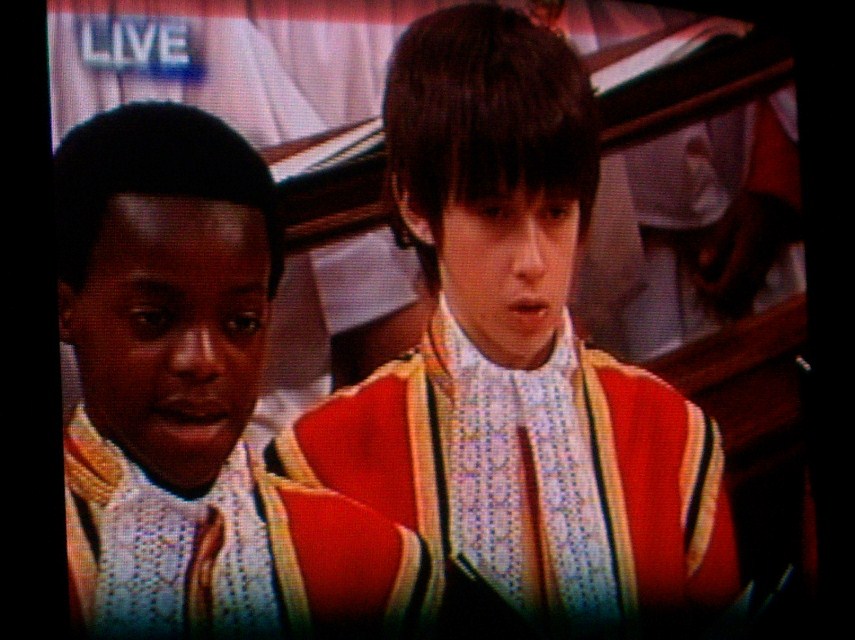
Westminster Abbey Boy's Choir. Assimilation, immigration, colonialism in the positive.
.
1.  On location.

London:  A City of vast history, remaining its own distinct entity, divided into several London Boroughs, rather than participating in an overall county system.  Counties and boroughs. Those apparently in the know say that parts of London may happen to be in a particular county geographically, it may be in another London borough economically. See http://www.englishforums.com/English/WhichCountyDoesLondonBelong/zjmjr/post.htm.  And a basic source, http://en.wikipedia.org/wiki/County_of_London

2.  An Event.  The Wedding.

London is, of course, the site of Royals.  Here is our update on London:  a look at old Mithraism showing there, the Telly and the Wedding, Immigration seen in Westminster Abbey, and Hats.  We sat with coffee, in bed, snapping pix.  Credits. Photos by This Commoner at the Telly, fair use of tiny snaps. Wavy lines by Telly people going up and down the screen probably to discourage home photos.  Undaunted, see here,
  • The Balcony Kiss. 
  • Topics at the wedding: 
    • Integration and immigration at the Boys' Choir,
    • Mithraism
    • The Telly and Changing mores (Elton John);
    • Institutional religion's compromises with Mithraism early on, leading to non-christian beliefs.
    • Hats.  These also attend the Wedding:  Royal, Wedding, Commoner, Clergy and Queen Victoria. 
 Then the rest of the wedding. Telly view of wedding.

I.  Events After Westminster

Best first. Nice cuppa, a little toast, a few pillows and enjoy. This, in case you could not tell, is a Commoner's home.


Snap, snap. Have to get between the sliding black line always going up, like a barrier at a wooden duck shoot at a carnival.

William, after.


Hats on the balcony.  Whose hat to the left? Camilla? Okay.  She's entitled.


And, before the momentous topics, see the couple on to live their lives, like the rest of us, but different.


II.  Real Life Observations at Westminster
.
Common global issue:  immigration, multinationalism, cultural identity, religious hold-overs that hold us all back.

Immigration. Assimilation, forced, encouraged, none.  Ethnic identity. Gains, losses for whom, what. 

Regular photos at section III.  As to multiethnicity,  England did it, at least for the course of the musical section of the wedding. Chorister choice.  Depends on voice and talent, as it should

The Boys' Choir.

Some 30 boys are in the Boys Choir at Westminster Abbey, see http://www.westminster-abbey.org/music/choir/ ; they attend the Choir School there, see http://www.westminster-abbey.org/choir-school.  There is also the adult male choir.  Ladies need not apply.


Can any country with a colonial past, or one that thinks itself superior to others, ever foster opportunity for others, while retaining the best of our heritage, and letting others do the same with theirs.  


Not assimilated.  

Women can and do teach and do other staff positions at the School, see sites and photos above. Typical selectivity under the guise of "history." So, it is indeed historical (hysterical?) that certain parts of anatomy are determinative -- more important to whether someone has opportunity to serve, than talent and smarts.


Yet the prevalence of ruffles suggests ambivalence. History crossed gender lines, but no on admits it.


Ruffles.

See FN 2; and an overview of Mithraism.  Was that among the first major religious system that excluded women from participation, that primary religion of Rome, old as 2800 BCE.  It appears that that element, among others of the old Roman State Religion, its militance, administrative skill, turf interest, was simply absorbed in order to get more converts for salesman Paul, regardless of its consistency with theology of the new Founder, whom Paul never knew.

Our traditions are more Paulian influenced Mithra, to woo Rome;  than Christian, so it would appear.

So there it probably is.  It appears that discrimination against women was not Jesus' idea, but was Paul compromising on theology with the Mithraists.  Anything to get a convert, even misrepresenting a founder and twisting into a new doctrine.


Faith restored:  Music of a different kind, to a different drummer. Welcome.


New York will permit them to marry now.  Either way.  Their choice.


Now:  Hats.  The Mitre.


 What do the ribbons on the clergy signify?  Curls?  Long hair?  What is the history of the mitre, the hat with two pointies.

These were Church of England clergy, but the two-horned mitre has a long history in the Roman Catholic church from which the protestants Sprang for various reasons.  See its pagan origins at http://www.onlinechurch.com.au/pagan-origins-of-catholicism-the-fish-hat-mitre-2  That site tracks the two-horned mitre to the priests of Dagon, fish god of the Philistines. See also http://www.tofm.org/papacy/pope_mitre.htm.  Of interest also are the vestiges of gnosticism, dualism that had been declared "heretic" because texts were interpreted other than the Roman orthodox wanted, see about horns of Mithra at http://www.gnosis.org/library/grs-mead/grsm_mythra.htm FN 1

Bride's hat:  veil.  Everyman's history is at http://www.veilubridal.com/history-bridal-veil.htm  The sites are commercial, so need to find a more historical view.

Bishop's hat:  Mitre from top view, all red inside. Now, that is weird and rather suggestive.


Other hats attract other kinds of attention.


Boaters will slide by, allowing attention to focus on the main event.  The danger of a snaky hat is that people will look at the hat and be more interested in it,  than in who you are. Which of Fergie's are you?


The Coach. To the Palace. William and Kate wedding

William about to step into the carriage.  Prince's hat, military.  Is that the Welsh Guard?


More royal hats.  And, in the Commoner's area, is that Queen Victoria?  It looks like a Queen Victoria crown.


III.  Westminster Abbey, The Rest of the Wedding

William and Kate. Surely we should not be on first name bases with royalty.  But it is more convenient than titles, when one has one and the other does not, yet. Duke and Duchess of Cambridge after, but before that, Prince William and Commoner Kate? 

Most self-explanatory -- 


William entering carriage, Westminster Abbey

Telly view.  Excellent.
.......................................


FN 1  Mitre and the Two-Horned Hat

Why do traditional churches keep women out, but wear their clothes. Keep the part of history that bolsters your own status, but forget the rest. Progress only on fronts that benefit.  Pass on the ruffles, for a religion founded by an anti-authoritarian itinerant pauper. Wealth.  Hoard it. Show it. Maybe we need that?

Do we?  We do know that the status of women in the Christian church, the traditional ones, is Outside.

Check your theological history.

This reflects, perhaps, Paul's need to placate the Mithra-ists of Rome, Mithraism as the State Religion before Christianization; and that took centuries.  In about 300-400 CE Christianity was adopted (Constantine as emperor 306-337 CE) and a tenet of Mithraism was no participation by women, and much secrecy. The bull (see the double horned hat here?) also featured. See http://mithra2004.tripod.com/Cult%20of%20Mithra.htm.  Click around for history, see also http://www.cais-soas.com/CAIS/Religions/iranian/Mithraism/mithraism_and_christianity.htm

See also Horns of Mithra, or other meaning, at Church of Saint Mary in Gdansk, Poland

Black Madonna, Horns of Mithra? Cathedral of St. Mary, Gdansk, Poland

Saturday, June 27, 2009

YORKSHIRE. Norse. Surname Scharfe. Yorkshire; Scarborough. Vikings?

YORKSHIRE
Norse Surname
Skarfr. Scarf and all its variations.


History through Names

A. Place names. 

Any map in the US may well show a place name that derives from England, or another country where the immigrants from it settled and wanted to feel at home. Paris, Maine. Berlin, Connecticut. Toledo, Ohio, etc. For British derivations, see http://www.nottingham.ac.uk/english/ins/epncurrent/keytoepn; or the home page at http://www.ordnancesurvey.co.uk/oswebsite/freefun/didyouknow/placenames/.

 B. Surnames

1.  Researching history through surnames.
.
Start with heraldry.  See Scharf, Scarf, similar spellings, at http://www.houseofnames.com/scarf-coat-of-arms.  This site notes arrival of these Scarf Skarf surnamed folk in documents in Yorkshire from the 13th Century, but undocumented people were there long before the writing about particular ones.  See the Viking Timeline at http://www.viking.no/e/etimeline.htm .  Yorkshire and much of Britain was ruled by the Danes and other Norse, back in the day.

Of immediate interest is the odd Norse surname, SkarfR, or Skarf (""Otkell Son of Skarf, from Burnt Njall's Saga, Iceland 12th Century recorded, earlier told).  Look what we get from JSTOR - one page.  See http://www.jstor.org/pss/3678466/  Or at Questia:  see this book from the 1930's - hidden away at ://www.questia.com/PM.qst?a=o&d=55440300 We don't want to get into all that bureaucracy.

If anything is public domain, that is. If not, let people be paid by the click from tax dollars - encourage everyone to research.

2.  Still looking: Yorkshire.  Found more affirmation of Norse roots - at http://www.yorkshire-england.co.uk/PlaceNameMeaningsPtoS.html/

Youtube asks, with Simon and Garfunkel, Are you going to Scarborough Fair?  Scarboro is in the Norse Tales as Skarthabork, and as Scarthborg and Vikings.

The Norse, of course, were not the first on the northeast coast of England - there were others, and Romans.  But the Vikings gave their names to the places in ways that lasted, more perhaps than the Romans.

3.  More history. Vikings began raiding in England in 787 AD. Conquest activity followed. See http://www.localhistories.org/viking.html/.

Danes conquered northern England in 866 AD, and the area that once was a Roman city, York, became the capital of Viking rule. Finally in 1016, there came peace with King Canute. Read there about the history of Viking raiding and invasions in Europe, down through Germany, Russia, Eastern Europe, Iceland, Spain (the Muslims defended, kept them out), Portugal, and traded with the Byzantine Empire. In Germany, the root "scharf" in Middle High German meant energetic active person; and scharpf is sharp-cutting, see http://www.ancestry.com/facts/Scharf-name-meaning.ashx/

4.  A blacksmith connection.

Viking craftsmen included blacksmiths, see http://www.localhistories.org/viking.html/ The root of "skarf" with all its spellings wherever the Vikings went comes from forge, or in the Orkneys, a shale-y place as where cormorants nested, with skarf as a term connected to cormorants (Skarfskerry, Scotland, see Skarfskerry Point at http://mapcarta.com/17621246) see Ireland Road Ways, Scarf - Scharfe - Scharf Ironworking, Norse Is that so? We are just enjoying ourselves here. Not experts.

Also mountaineers perhaps, or reference again to shale, at Skarfjellet, Norway.  The mountain, near Sunndal, see http://www.mountain-forecast.com/peaks/Skarfjellet

5.  And in the 1800's, there were four Scharfe families in Yorkshire.
  • Thomas in 1831,
  • Hadassah A. in 1837,
  • Agnes in 1837, and
  • Thomas H. in 1872. See Scharfe Family History at Ancestry.Com at ://www.ancestry.com/facts/Scharfe-family-history-uk.ashx/ This would not be our group, except in name, as our Scharf-Scharfes settled in Ireland.
6.  A Jewish connection with the name evolved.  Skarf is a Norse name that moved into Germany, Poland.  Did it come with the Vikings in those waterways, who then settled, intermarried.  The rivers went deep into the countries, and the longboats were shallow-drafted, and fast. See Denmark Road Ways, Roskilde Viking Ship Museum.

However the name moved and was adopted,
7.  Interest in Hadassah.

Back to history, and Jews in England - back to the beginnings?

There was a massacre of Jews in York in 1190 - there is a Hadassah Scharfe in Yorkshire in the 1890's - see http://search.ancestry.com/cgi-bin/sse.dll?rank=0&gsln=Scharfe&f1=Yorkshire&db=uki1891&gss=genfact/ That Hadassah is the Hebrew name for Esther, with connections to the myrtle, used in perfume. See http://www.abarim-publications.com/Meaning/Hadassah.html/

Hadassah is also the name of the Jewish women's Zionist organization.

Jewish connections? Given the Viking wanderings, settlements, raids and conquests, that would not be unusual at all.

Looks like the connection became strong.  A Lauren Scharf in Ohio US gave some records to Hadassah the organization there, so is there a Jewish branch of us? See http://www.americanjewisharchives.org/aja/FindingAids/hadassah.htm/ The name comes up. Everybody intermarries with everybody all over the world, so welcome, family. Come to think of it, we were detained in 1961 from entering Israel from Egypt because the "scharfe" was thought to be what? German therefore Jewish or Jewish? We never knew. After an hour we were allowed in. Or was it going from Israel into Syria and Lebanon? Maybe that was it.

The e in our name came only in the 20th Century, to keep all the Ireland-originating Ottawa Scharfs identifiable for the post office. We still would like to know about Hadassah Scharfe.

SkarfR.  Scharfe. Scarf. Scarth. Scarff. Skarf.  Norse roots.

..........................................

Side interest: "wic" means trading place, see http://www.localhistories.org/york.html/ Eastwick? Southwick? How about Pickwick? Wicca? Wickman?

"Land" is a Viking word, and that became attached to the Gaelic "eire" = Ireland.

Suder means South, so Sutherland (Scotland at the north). See Viking history at that allhistories site, click and find yourself at http://www.localhistories.org/viking.html/ Upper class Vikings: Earls. Farmers and craftsmen: Karls. See http://www.localhistories.org/viking.html

 Copyright over-restrictions:  Consider the merits of Copyleft, see http://www.gnu.org/copyleft/ - a way to open up use of material, while protecting the originator.

Friday, May 30, 2008

WILTSHIRE Sarum, Salisbury area

Wiltshire, the District 
.
The area is a layer cake, as this site describes parts of it - history of Sarum, see below, at http://www.timetravel-britain.com/articles/castles/sarum.shtml.

From surface to deep below, are  successive cultures, religions for the ages. Burial practices, historical developments taking place within short distances, Cathedral, little hamlets with little Norman churches, like Mildenhall.  There ere are two Mildenhalls, one north of London with a military base, and then this little village they pronounce as "Minal" if you are looking.

In the area, an Iron Age hill fort, Caer Guorthigirn, or Vortigern;  then Roman Sorviodunum after the Roman invasion in 53 AD, Saxons fought over it in 554 AD, and more details (some reliable or not) from a travel chronicle dating back to 1480, see http://www.vortigernstudies.org.uk/artcit/caersalis.htm,

1.  Stonehenge:  see preceding post.
.

2. Old Sarum: 

Old Sarum is the original site of the town now located further to the south, where reliable water is, and known as Salisbury.  Work building the banks of this old site, the earthwork area began in about 5000 BC - a fort by 1000 BC, and the town on top of the mounded area. This town was in use through the time of the Romans and Normans, and finally the center of life moved to Salisbury, about 1219 AD. See http://www.britainexpress.com/Where_to_go_in_Britain/Destination_Library/old-sarum.htm
.
Old Sarum had religious significance from early Christian times.
.
"The Sarum Use" is an old liturgy that formed the basis for the later Book of Common Prayer, Church of England, the Common Prayer dating from 1549. View the Sarum Use, parallel Latin and the English, here - at http://ia331338.us.archive.org/0/items/theancientliturg00maskuoft/theancientliturg00maskuoft.pdf. 

Hear and see Sarum Use at http://wn.com/Sarum_Use
.
Or, go first to this site for an overview, and then click to view. See http://justus.anglican.org/resources/bcp/Sarum/index.html; overviews back at at http://www.britainexpress.com/Where_to_go_in_Britain/Destination_Library/old-sarum.htm.
.
A new book is coming out on that liturgical Sarum Use, says http://www.thecityandthecity.org/2008/04/new-book-on-the-sarum-use/. The liturgy is also known as the Sarum Missal. See http://justus.anglican.org/resources/bcp/Sarum/index.htm

.
Good older beach book: "Sarum - The  Novel of England," by Edward Rutherford, 1987, see http://www.goodreads.com/book/show/92163.Sarum.
.
Salisbury. Apparently people needed water and the high earthwork town did not access it easily, thus the move to Salisbury and the vast Cathedral there,  see http://www.salisburycathedral.org.uk/; and http://www.thetravelinsider.com/britain/salisburyintroduction.htm
.
It is possible to see much in a day.  FN 1
................................................

Fn 1.  Travel philosophy:  enjoy the full travel day, even after supper.
  • Getting around.  
 How do we cover so much in two weeks with a rented car?  Remember the short distances and small size of European countries. Go back to your globe and superimpose England, for example, on the US. Our car trips are not frenetic at all. They just unfold. Stonehenge, the Salisbury Plain; Old Sarum, 500 BC, see http://www.english-heritage.org.uk/server/show/nav.16426; Salisbury Cathedral, all an easy motorway drive from London and then south - short compared to the distances here. Easy to visit from London to Stonehenge, Stonehenge to Old Sarum, and then to Salisbury for the night.

Sunday, December 30, 2007

LEEDS COUNTY - Travelers (Gypsies, Roma) in England

 LEEDS COUNTY
TRAVELLERS or TRAVELERS

Leicestershire and Cumbria
 .
Each country has its own narrative about its Roma, or Gypsies as they used to be known elsewhere, the groups being different.  See Gypsies, Roma, Romani.  See the "History of Travelling" at http://www.travellersinleeds.co.uk/_travellers/HistoryEngland.html, for the Roma or Romani or Travellers in Leeds, England. There is a Roma-oriented site for Leicestershire as well, and it presents a brief chronology of historical events to prove its points of persecution of Roma, see http://www.leicestershiretogether.org/antiziganism.pdf

See the mechanics of emigration at  http://englandroadways.blogspot.com/2012/01/cumbria-sheffield-immigration-19th-c-to.html. Did more emigrants go through Liverpool?  Where would passenger lists be, to find backgrounds of converts? 

Leeds:  Leeds appears to be central to Roma in England.  It also has an industrial underbelly, see history of its feltworks and other industry and the people who worked there, in "Foreigners," by Caryl Phillips - http://www.guardian.co.uk/books/2007/aug/25/society; see Hello, Fodder - Racial Fodder post.  Immigrants, or cast-off ethnic groups, similar issues.  That story of immigration centers on three individuals, including one David Oluwale, a Nigerian immigrant who died under such suspicious circumstances while in custody, and related issues of racial targeting in England. 
  • Update:  a current candidate for president in the US -- Mitt Romney -- a Roma, Romani name? 
  • Contemporary politics: Someone ask how Mitt Romney would address access to opportunity issues as to American Roma? Ask even if his name cannot be traced to Romani origins. Ask anyone seeking elected office, as to any ethnic group.
 The Travellers in Leeds site is a central site for Travellers, with links to various needs and interest groups. It shows by maps and pictures and chronological events where Gypsies came from, and their earliest connections to England.
  • In England, there is increasing unrest by the community people against the Travellers, as there is in many nations not only against Roma, but any ethnic immigrant group on the move in. See http://www.abc.net.au/abccontentsales/s1519912.htm. It looks like similar immigration issues are arising worldwide, as peoples cross old boundaries. Distrust, resentment, efforts to dislodge without a place for them to go, etc. And the healthcare provided is abominable, like here. See http://www.news-medical.net/?id=22350.
Governments maximize use of words about them and the government's great plans for enhancing opportunity, sustenance. See http://www.83.137.212.42/sitearchive/cre/policy/gypsies_and_travellers.html.  Would a better solution to forced settlement and the poverty there, and loss of occupation, to provide for access to healthcare and sustenance and let them travel? Leave a culture alone if they want it?
Roma are in the news and media now, especially with the imaginative, and not much historical, film, "The Golden Compass," This topic is too much for one post, with the film so please visit Gypsies, Roma, Romani. The post on the film is at Golden Compass.
  • Scotland and a cultural history angle, see the post on Johnny Fa, the Scottish gypsy in ballads, at 11/12/2007, Johnny Faa.
    • As to Johnny Faa's surname, we find no connection to the solfege do-re-mi-fa-so-la-ti system - see http://en.wikipedia.org/wiki/Solfege. Will keep looking. Perhaps Mother Faa sang?

Sunday, December 16, 2007

WARWICKSHIRE - Warwick Castle - A teaching castle

Warwick Castle
Warwickshire
.
Mighty Warwick, not far from Stratford-on-Avon. Castle of the curtain wall fortification, a nearly impregnable perimeter, see http://history.howstuffworks.com/middle-ages/castle5.htm.

Early on, the site was a Roman fort, in 79 AD (see timeline at http://www.castles.me.uk/warwick-castle-facts-timeline.htm), a burh, a fortified town built by Queen Aethelflaed, widow of King Ethelred in 914-916, as a defense against Vikings.  See http://hearteng.110mb.com/warwick.htm,  The Saxon sheriff before the Norman conquest may have been related to Lady Godiva and the king of Mercia, the Anglo-Saxon kingdom of the day.  See timeline.  He also (traitor?) switched allegiance from Anglo-Saxon King Harold to William when William won, for which he was greatly rewarded in lands and honor but not by his own people.

Then more serious fortifications ensued with a timber motte and bailey by the forces of William the Conqueror after the successful Norman invasion.   He needed many were built fast, in order to subdue the population after his invasion in 1066 from Normandy.
 .
Motte and bailey Warwick began in 1068.  Method:  Choose the highest ground, even build a mound, rather steep, as the motte; add a second mound on the first, surround that smaller one with a wooden fence at top and build tower inside for a lookout, and accommodation for the noble and others - the bailey.  http://www.castles.me.uk/motte-and-bailey-castle-layout.htm.  Earth for constructing the mounds came from below, with a handy ditch resulting all around, also good for defense.

In 1260, the wooden structures were replaced with heavy stone walls and structures.
.
Warwick Castle, Warwickshire, England. Interior display, a war room. Which rebellion?
 .
In medieval times, the Castle could be inherited either by males of females, through either line.  http://www.castles.me.uk/warwick-castle.htm
 .
It served as a fortification, a prison, a seat of Royals.  Romans, Saxons, Celts, Vikings, all in the area making their mark.
.
Warwick today is an educational site as well as a furnished castle and 60 acres of grounds.  See the scenes set inside with wax figure mock-ups of historical events. Put yourself there. Dan did. Go to this tours and photos site for a full view:  http://www.google.com/firefox?client=firefox-a&rls=org.mozilla:en-US:official. Do a search for Warwick Castle panorama and you will find an interactive site for a 360 all-around tour.
 .
This place is becoming very commercialized. Arrive early or late to beat the buses. Click on the history of Warwick at that site (you have searched for Warwick Castle panorama).  It has been inhabited continuously until recently; home to Earls of Warwick until recently;  town destroyed by 17th century disastrous fire, rebuilt, used as setting for many TV and film ventures.