Thursday, December 06, 2018

Mendenhall - Minall - Mildenhall connections. Ancestry ifs.

A comment appeared at this site re documentation of Mendenhalls.  Suggest:  Start at the Mendenhall Family Association at https://www.mendenhall.org/.  Our last personal foray into ancestry (this is my husband's side; his grandmother was a Mendenhall) was decades ago at a reunion at the Mendenhall Inn, Brandywine Valley, Mendenhall, PA, and Kennett Square.  The Kennet River runs through Mildenhall, Wiltshire, England;  see Kennett Square, PA.  Mendenhall land:  The Mendenhall married a Wilson, land included  at Toughkenamon, Chester County, PA. Understood that the Mendenhall family came over with or contemporaneous with William Penn, but I never went into documentation.  Enjoy!  Easy start, but verify, at https://www.wikitree.com/wiki/Mildenhall-46:  
"JOHN MENDENHALL was born on 30 Oct 1659 in Marridge Hill, Wiltshire, England. He died on 19 Aug 1743 in Newark, New Castle, Delaware.
"He was born with the last name of Mildenhall. When he and his brother Benjamin came to America the spelling was changed to Mendenhall. All their descendants used this spelling."

Cookie notice

Third parties may place cookies on this site. That is beyond our control. Please be advised.

Monday, August 29, 2016

Nottingham and Robin Hood. Sherwood Forest.

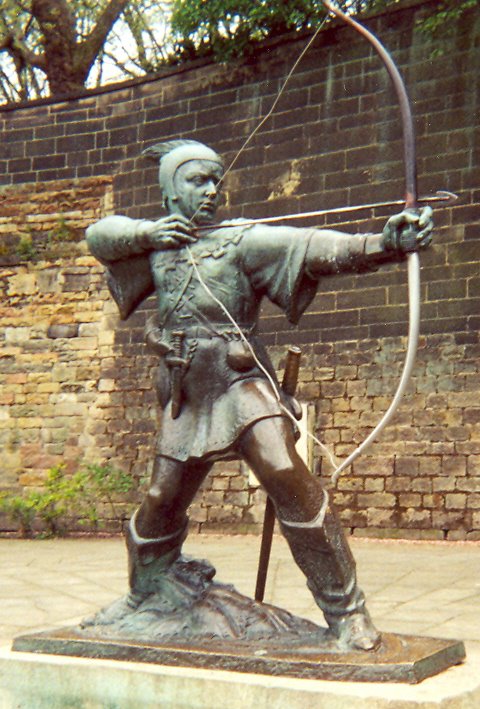
Robin Hood statue, Nottingham, England


Robin Hood. He is understated in his town, Nottingham, and in his woods, Sherwood Forest. See http://www.localhistories.org/nottingham; and  http://www.robinhood.ltd.uk/robinhood/legend. There is a fine interactive museum, however, with tableaux and details and old ledgers.

  • Update to 2016:  New archeological finds at nearby King's Clipstone, a village where The King's Houises, a/k/a King John's palace documented in 1164 are laid out at Archeology Magazine, Sept-Oct 2016, see http://www.archaeology.org/issues


Robin Hood, according to the exhibits, is a generic type of name, like John Doe, used for any unknown petty criminal or other hapless individual arrested for whatever.

 Robin Hood did this, Robin Hood did that. See the ledgers through the years.  All those activities over that long period of time could not have referred to one person. But as anywhere, stories illustrate larger truths, and may well not be true in themselves. Legend, myth. Robin Hood. See the tales at http://www.robinhood.info/robinhood/candidates.html

Many Robin Hoods:  Perhaps the main model for our Robin Hood was one Robin fitz Ooth, Earl of Huntingdon, born 1160, died 1247, Or Sir Robert Foliot, 1110-1165, or Robert Hod, or Robert de Kyme, 1210-1285, Robert Hood of the Wakefield Roles, 1290-1346, or several others not listed at the robinhood info site above.  Or a collage.

 Once a figure is identified, religions or social, the stories collect, and soon have a life of their own.

Sunday offers limited visiting hours. Visiting on a Sunday is good for leisurely strolls and a less crowded museum; but not all exhibit areas are open early. The underground caves and dungeon areas beneath the castle area did not open until much later.

Sing it again, Robin Hood riding through the glen, at https://www.youtube.com/watch?v=2w7ALMIUy74

Update 2010:  the new film, Robin Hood, at http://www.imdb.com/title/tt0955308/, is fun and fast-fighting, but nothing at Nottingham seems to support the details.

Friday, July 15, 2016

Worcester. King Ceowulf II of Mercia, defender of England. Move over, King Alfred of Wessex.

Hwaet! An ally of King Alfred of Wessex seeks his time on the stage as a hero of England, against the Vikings.  Co-efforts shown on coins with faces together, equal, as to Alfred and Ceowulf.

Share, children.  Share.  History rewrites by the chroniclers serving the agenda of the king best equipped to chronicle, rule the day, but eventually some do get corrected.

Here, the chroniclers of Alfred the Great, King Alfred of Wessex, who beat back the Vikings at Edington and is therefore a great hero, had help.  Not only help, but perhaps the efforts of the unsung King Ceowulf II, king of Mercia 874-877 were dispositive.  Coins have been found that display Alfred and Ceowulf equally on the face of the coins.  A few of them had been found earlier, but a new discovery shows the widespread dissemination of them and points to a strong alliance between the kings. See support at http://www.historyfiles.co.uk/FeaturesBritain/EnglandCeolwulf01.htm

Ceowulf is not only written out of history, the few accounts of him are unfavorable. See http://www.archaeology.org/issues/208-1603/trenches/4165-trenches-england-viking-hoard
Ceowulf was dismissed as a "foolish king's thane" holding lands for the interest of the Vikings in the Anglo-Saxon Chronicle, see historyfiles site, and http://www.anglo-saxons.net/hwaet/?do=get&type=person&id=CeolwulfIIofMercia, for example.  Instead, he was independent, a "shrewd negotiator" (see anglo-saxons.net site), legitimate king, and with friendly relations as to Alfred.

Thursday, July 14, 2016

Glastonbury Abbey: Archeology and King Arthur

Archeology at Glastonbury Abbey.  Review of the old, and exploration of the new: Glastonbury Abbey back in the news  Archeology may produce ambiguous results, but continual look-backs are valuable. What was dismissed, or advocated earlier, may be a springboard for new information.  Here, the Abbey site was indeed occupied in the 5th Century, the time of King Arthur, but alleged remains of his body and that of Guinevere?  Not definitive, not really anything.  Just a pit.

Here, the interface of legend and fact, see Legends of Glastonbury at  http://www.archaeology.org/issues/208-1603/trenches/4172-trenches-england-glastonbury-abbey

Timeline highpoints

33-35 CE -- Legend.  Joseph of Arimathea, holder of the Holy Grail (do a search) founds "Christian" church at Glastonbury.  Church?  What institution was in effect so soon after the death?  No mind.

5th Century -- Site is occupied, with "definitive proof" at the Abbey site, and this from the time of the actual King Arthur, see Legends of Glastonbury

600's -- Saxons, now Christian, conquered Somerset county. King:  Ine of Wessex, who built on the Abbey site, see http://www.glastonburyabbey.com/history_archaeology.php?sid=38bbee268aa83067928b28b92614b9ff

1066 -- Norman invasion.  Normans added to the existing structures at the Abbey.

1184 -- Huge fire at the Monastery, see Glastonburyabbey.com site.  Monks rebuild, with some new but old-looking structures, to add to the pilgrimage value, see Legends of Glastonbury site.

1191 -- Monks at the Abbey find a log, hollow but with two bodies inside and a cross with the inscription indicating that here lie "King Arthur and his wife Guinevere."

1278 -- Edward I oversees reburial, bones said to be the royals Arthur and Guinevere

1536-1541 -- Protestant Dissolution of the Monasteries, with Glastonbury Abbey included in 1539.  In 1536, there were 800 monasteries, convents, friaries, reign of Henry VIII.  By 1541, none, with 10,000 religious persons displaced. See Glastonburyabbey site.

1904-1979 --  Era of 36 or so excavations, but unpublished, often misinterpreted

1950's - 1960's -- more excavations, but affirmative evidence for the royals Arthur and Guinevere are contested.

Friday, August 23, 2013

England and Pulp Icons. Country Life. What's For Sale?

Country Life. British pulp magazine in large glossy. 

This is a magazine, oversized, laying out Brit properties for sale.  Property!  A British obsession.  Look at the house hunting international. The British talk of property. The concept uber alles. Not just a piece of real estate, but a property.   Great estates just for you.  Photography.  Vistas.  History.  A delight over coffee before the stress of the day o'ertakes.  Who would not enjoy it? Things for sale.  Acquisition.  Profit.  Find this icon for the uppah classes and wannabes who drool, at http://www.countrylife.co.uk/

For sale signs.  All over for the Brits to pick and choose.

Who else is property and, accordingly, pointedly included as available?  Ah, yes. The youngish or still-searching Ladies. The bloodline preserves the concept of property. If the property goes by male primogenture (does it still?)  marry up to one of them. Get in line.

  • In each issue, toward the center, more toward the prominence of the beginning than the afterthought of the ending, is this.  The Broad of the Day.  Somebody's Lovely Dottah!  A dewy or airbrushed blooming young thing, or a little past young but hunting for a permanent buyer.  Lady this or that.  The daughter of Who Big and Who Bigger and the genealogy for all to scrutinize.

Buy me says she.  Like Alice in Wonderland.  A cookie.  Eat me. A poor one. Shrink.  Wrong cookie. Eat me.  Grow. 

So, asks she, who will my husband be? 

Go to Country Life and see the dames' daughters in waiting.  There should be an audio attached.  Perhaps a scratch and sniff for the hedgerows.  Ha-has.  See the function of the ha-ha, to preserve boundaries without spoiling the view. at http://www.bbc.co.uk/legacies/heritage/england/teesside/article_1.shtml


Go for the before centerfold first, like in Playboy. 

That's the spirit. Pip pip.

Friday, February 01, 2013

WILTSHIRE. Stonehenge and Healing; Acoustics

 STONEHENGE
Ceremonial, Healing, Acoustics, Other? 
2020 update

The origin of the tallest Stonehenge stones is a mystery now solved.  See the BBC https://www.bbc.com/news/uk-england-wiltshire-53580339.  The "sarsens" come from a distance of some 15 miles from the site, near Marlborough.  The lower blue (not really) stones come from Wales.  This discovery stems from matching a core sample from the 1950's, now returned to England, to nearby areas.  

This one, frowning, is one of the low stones.
 

Stonehenge is a setting of ancient ceremonial standing stones near the town of Amesbury, in Wiltshire. Find it at http://www.aboutstonehenge.info/index.php?pg=stonehenge-location. 

The site is an easy ride from the airport at Heathrow.  A motorway after landing eases practice driving on the left on where there are lots of lanes.  What is Stonehenge?  There are various and ever-changing theories. It continues to amaze.

In addition to its ceremonial attributes, Stonehenge was an acoustic wonder.  By way of update,  today, New Year's 2013, a New York Times review by Katherine Bouton of the book, Discord, the Story of Noise (book by Mike Goldsmith) notes that Stonehenge originally was an acoustical marvel. In 2600 BC, its sound reverberated much like a concert hall, thanks to "thanks to the smooth and slightly curved inner face of the stones," see http://www.nytimes.com/2013/01/01/science/discord-sound-noise-and-our-elusive-quest-for-quiet.html
.

We had been told that this was a place of sun worship - example http://www.english-heritage.org.uk/server/show/nav.16465. With the carbon-dating of cremated remains that had been in storage, archeologists then said that the purpose of Stonehenge is clearer. It was a burial ground, and apparently for rulers that dominated the area for some 500 years. Stonehenge itself dates from about 2500-3000 BC. See http://www.chicagotribune.com/news/nationworld/chi-stonehenge_30may30,0,3850894.story

.
Earlier Update 2011-2013.
 .
Research and archeology are now finding more to this famous setting of monolithic standing stones at Stonehenge, Stonehenge long thought to be for ceremonial and/or burial purposes.  There are other henge monument traces nearby, remains of a mound circle,  gaps, ditches, seen by below-ground imaging and without the digs initially, see  http://www.archaeology.ws/stonehenge.html.  This also dates from 2500-3000 BC, as does mainstream Stonehenge.  Named Bluestone Henge in 2009, at its discovery (after our trip),

Stonehenge, for all its other possible uses, was apparently also a place of healing, its own Lourdes where those with illness or deformity could come for relief.  See http://www.bbc.co.uk/history/programmes/stonehenge/


See September 2008 articles, at http://www.msnbc.msn.com/id/26838058/

Early pilgrims coming to Stonehenge - pre-Christian came from other parts of Europe, not just local. This was the Neolithic era. Some skulls even show signs of surgery (didn't the ancient Egyptians also drill through skulls successfully?), see http://www.usatoday.com/tech/science/2008-09-22-stonehenge-healing_N.htm
.
Current dating: at 2300 BCE (Before Christian Era), and more precise than the broader range laid out before,  see http://www.findingdulcinea.com/news/science/September-October/Stonehenge-Said-to-Be-Place-of-Healing.html

2. Logistics

Comment reply -

  • We were able to get very close, but not to touch. Park across the highway, then follow the pedestrian tunnel underneath to the stones' side. There was a gravel walkway around a tight perimeter, with some stones nearby on the other side of the walkway as well. There was a very light wirey fence, nothing formidable, more a guide. We could not wander freely inside the main area of the stones, however.  Everyone stayed on the walkway.

Tuesday, December 11, 2012

Dartmoor. Saxon Roots. Widicombe; Widukind?


1.  Widecombe.  An old town of Devon, Dartmoor. Spelling sometimes Widdecombe. Inspiration for the jolly rouser about Uncle Tom Cobley and all, perhaps on the gray mare at the Widecombe Fair, see https://www.youtube.com/watch?v=16chelA5pTc. There is apparently a traditional Saxon Well nearby; the area was a Saxon administrative center centuries ago, see http://www.moorlander.co.uk/about_dartmoor.html

The area's inhabitants resisted William the Conqueror in his push westward, requiring William to build several castles (not seen by us) to establish his domains. 

2.  Saxons. Where is the research about them in particular, not just the Domesday or general Old English ideas?

Our understanding is that Saxons arrived along with or not long after the first Angles, when the Romans left.  See http://historymedren.about.com/od/sterms/g/Saxons.htm. Angles and Saxons intermarried apparently, or at least did not severely conflict with each other, and voila, Anglo-Saxons.  The royal mints for Saxon Kings Ethelred, Harald, Edward, were located at Dartmoor.  See Moorlander.  Widecombe-in-the-Moor: a topic of great tomes, see this 1865 Google Book, Western Antiquary.  There was an Anglo-Saxon settlement at Dunstone, see http://www.widecombe-in-the-moor.com/about.php, and the word root dun itself as Saxon, see http://dictionary.reference.com/browse/dun

3.  Venture farther back than Saxons already in the British Isles.  Move to their own source, many in Saxony.

In Saxony, pursue a famous chieftain of the Saxons, Widukind, who harried Charlemagne for some 30 years before forced to capitulate, as he did in part.  See Germany Road Ways, http://germanyroadways.blogspot.com/2010/12/enger-widukind-saxon-bane-of.html.  A church dedicated to him, and containing bones said to be his (no comparative DNA?) behind the altar are at Enger, Germany.  See http://germanyroadways.blogspot.com/2010/12/enger-sudden-saint-widukind-and-church.html. 

The fine statue of Widukind at Enger, a pride of the town, was melted by the Nazis for war materiel.


Some spellings, some phonetics, are so close as to suggest a connection between otherwise separate-looking ideas, places, histories.  After finding Widicombe Fair in an old piano book of folksongs, listen to it at youtube again, above, and then think of the Saxons, some migrating peaceably to the British Isles in the course of things; others forced out by Charlemagne after Sachsenhain's slaughter, numbers may vary but the impact on the population did not, see http://germanyroadways.blogspot.com/2011/02/sachsenhain-saxons-grove-charlemagnes.html

4.  Widukind's folk to Widecombe?

Saxon Widukind's kin to live on, in a way, in Dartmoor? That is up to the venerables on the moor:  can you check for us?  The root "wid" also is of Scandinavian-Saxon origin, do a search on Google Images for Runes Widing for an example of an amateur etymological sleuth enjoying life, and matching an old family story with old runes.  WID.

Runes.  Here experts are needed.  Our look into runes WID and runes produces fun, but little to withstand a serious researcher on the root wid, as it is also found in old incantations.  See http://swedenroadways.blogspot.com/2010/07/anglo-saxon-runes-ingwaz-moves-widing.html

The surprise is finding so little about Saxon roots in the Dartmoor materials.  Spur on. Inform us all. Please.

Friday, March 30, 2012

Rochester, Charles Dickens, Kent

Charles Dickens and Rochester

Rochester was founded by the Romans in some 53 AD, but often that would have been on a site earlier used by others.  Charles Dickens' moved there when he was a child, and his father was struggling to support the family.  He, the father, was constantly in debt, and in and out of debtors' prisons until he lucked out on one job -- found his employer a cheat -- blew the whistle, and then could move elsewhere for a fresh start.   The senior Mr. Dickens was the model for Mr. Micawber, one of the characters in Great Expectations.
.
Joseph Clayton Clarke illustrated much of Dickens, here Mr. Micawber,  fair use.  Smithsonian magazine has a fine article on Dickens, at Going Mad for Charles Dickenshttp://www.smithsonianmag.com/arts-culture/Going-Mad-for-Charles-Dickens.html
.
Mr. Micawber, from David Copperfield:

.
Our additional Kyd illustrations are still framed, so a little dark.  Enjoy!
.
The Artful Dodger, from Oliver Twist:
.

Sam Weller, from The Pickwick Papers:

.
Uriah Heep, from David Copperfield:
.
Mr. Pickwick, from The Pickwick Papers:
.
.
Charles Dickens' life was complex, as anyone's.  Meet Ellen "Nelly" Ternan, at http://www.smithsonianmag.com/arts-culture/Dickens-Secret-Affair.html?onsite_source=relatedarticles&onsite_medium=internallink&onsite_campaign=SmithMag&onsite_content=Dickens'Secret Affair

Sunday, February 26, 2012

Rule, Rhubarbiana. West Yorkshire M1 and M62.

Rhubarb country.  Food alerts. The Rhubarb Triangle.  An inauspicious-looking triangle where the M1 and the M62 motorways intersect. The Financial Times zeroes in.  See the highways at http://www.motorwaycameras.info/.  That would be West Yorkshire:  bounded by Wakefield, Rothwell, Morley.  Go from Manchester to Wakefield, and continue south to Nottingham, perhaps. 
.
Why?  Because rhubarb is a metaphor for the dedicated, stubborn life, growing where little else of value will. Bad climate, lots of waste from wool industry waste known as "shoddy", but good roads for transport.  See Fool's Paradise, on our US paper edition, The Rhubarb Ruse, at http://www.ft.com/intl/cms/s/2/2db41de4-4c88-11e1-b1b5-00144feabdc0.html#axzz1nV2gxhkV.
.
What else but rhubarb: it takes a ruse.  Kid the plant into thinking spring has sprung. Leave the root out during fall; let it feel the sharp frost. Then take it indoors where it is warmer, and it will think it is okay to grow. Or, if it is too mild, apply an acid. See details. 

Rhubarb poisoning. Do not eat leaves.  We did, nice and chopped and sauteed, but it did not taste tastey. Hop on the internet: poison. Rhubarb info, poison! Fast to poison control at the drugstore, call Poison Central. Everybody fine.  Noone seems to post the antidote process, so just remember to call.  

Tuesday, January 10, 2012

Cumbria, Sheffield, Mormon History. Mormon Convert Immigration 19th C. Coming to America

Mormon History
Convert Immigration from England
19th Century
Perpetual Emigrating Fund
.

Mormonism.  Converts. History. The fast rise of a religion. Here, the impact on historical interest triggered by a Mormon candidate for the presidency of the United States/

1.  Roots of Mitt Romney.  Cumbria.  Dalton?

The current American presidential election process includes a Mormon candidate, whose forbears are traced, apparently, to 1837 or so, to Cumbria, Dalton in particular, see  http://www.in-cumbria.com/white-house-hopeful-s-connection-to-furness-1.908148?referrerPath=news-archive.  This is an area that includes the Appleby Horse Fair, held 2011 on June 3-5.  This event attracts thousands of people of Traveler, Gypsy heritage, see http://www.applebyfair.org/
.
Interest simmers, not a big deal, on the ethnic roots of the candidate:  Mitt Romney, with Romneys in England for several centuries.  And in the process of Mormon conversions and financial support for converts.  See http://martinlutherstove.blogspot.com/#!/2012/01/mormon-converts-19th-c-owned-by-company.html.
.
With a name, Romney, so like Roma, Rom, Romany, we looked around. 
.
2.  Are there roots in Romney Marsh of Kent.

And, the closest connection for Romney with Romany or Roma or Rom (Travelers, Gypsies) is in the Romney Marsh of Kent.  This is specifically stated also as the Romany Marsh, see http://www.infobarrel.com/History_of_Romney_Marsh_kent.  A smugglers' haven -- wool, brandy, tea. Special breed of sheep that do well in the wet. The identification by surname and ethnic name is tenuous to be sure, and certainly in the dimmer past, but not so far fetched.  Will our Mitt Romney take an interest, ever, in migration, ethnic groups, and their opportunities.
.
3.  The rise of Mormonism

Mormonism, properly known as Jesus Christ Church of Latter Day Saints, or LDS, began formally in America in 1830 by a previously unknown person, one Joseph Smith.

The religious sytem rapidly spread by means of LDS missionaries abroad, particularly in England. This activity resulted in a large migration of newly converted believers, thousands from the mainly industrial cities and worker neighborhoods (is that so?). These new Mormons emigrated to harbor areas in America from Boston to Louisiana, and then to gathering points to Utah by wagon train, see the BBC overview of basic beliefs at  http://www.bbc.co.uk/religion/religions/mormon/ataglance/glance.shtml.

Our candidate's family in Dalton was apparently converted in 1837. Who were they, to take on something so new? Are there any birth or death records prior to 1837, land holdings.  Or were they, as so many of our own forbears, not within the established cultural system.

Dalton is eager to claim Mitt Romney, see http://www.daltonlocal.co.uk/us-republican-politician-mitt-romney-s-dalton-heritage-goes-back-to-1642-1.907821?referrerPath=home.  See all the connections with family that that site lays out, tourists ho. An interest remains in photos, birth records, gravesites, documentation, of Church of England or Roman Catholic heritage, or other mainstream British Christian.  This documentation of Romney heritage would offset the clear suggestion that, at some point, a Romani family assimilated. All we need are the documents, the vetting.

The BBC identifies working class British as the primary converts, as industrial conditions were so harsh on laboring people. And there were also the poor, no resources. The BBC identifies Sheffield in particular as a human tragedy, for whom an alternative, a religion that welcomed them and would help them get to America, was a magnet.  See "social misery" at http://www.bbc.co.uk/legacies/immig_emig/england/south_yorkshire/article_1.shtml

4.  Financial help to converts.

Cash offered help to the poor and middling in their conversion.  The Mormons' Perpetual Emigration Fund or Perpetual Emigrating Fund, see Google Book Journal of Discourses of Brigham Young1854, on the establishment of it: reasons, methods.

The Perpetual Emigration Fund, or PEF, accordingly, was set up as a corporation by the Mormons in 1849, by which converts got free passage to America in exchange for repaying the amount (how much? was there interest? were fortunes made on a profit between passage costs and amount charged) -- a kind of indentured servitude a the American end? Or a huge student loan idea -- could the people get out of it if they changed heir minds?  In either event, it was a helping hand, get people over here, get them started.  Some, of course, never repaid; but benefited nonetheless.

Brigham Young was eloquent on the need, and the results, see http://scriptures.byu.edu/jod/jodhtml.php?vol=02&disc=14.  There is much on the subject, see another Google Book, Western Lives, a Biographical History
.
5.  Romney: Long history after emigration.

5.1.   Does length of residence mean superiority:  look at emigration through current lens.
.
Does emigration prior to 1900 or so mean superiority.  It means more time to amass wealth before income taxes, to exploit before the rights of others gained acceptance, but individual merit? Does any brilliant person pass those genes or influence on beyond the second generation?  Experience says, after the second generation, people become hangers-on.  Who left in immigration waves:  the successful, or the seeking.
.
5.2  If Romney has other-ethnic roots, different from pure "English" in the cultural tradition sense, that should help in his tolerance of other immigrants.  The Romany Archive and Documentation Center in Austin , Tx, would also like to know, we think.  See RADOC at http://www.radoc.net/radoc.php?doc=presentation&lang=en.


Why care?  Immigrants and immigrant rights (some would say there are no rights if persons enter without advance documentation) are in hot issue in America.
.
If this candidate knew that his heritage at some point was not English Upper, or even Middle, but even Traveler; or, English working class, would he be more amenable to human aspirations.  If his forebears were laborer, those who may not have been in misery, but had advancement roads blocked in the 19th Century, would he be more willing to stand up for those similarly disadvantaged, who don't have a handy Mormon conversion in their own country to help them. 


Or is Mitt Romney of the Dalton Romneys now just another profit-obsessed CEO:  if capitalism allows the big to swallow the little, why fuss?  That is an election issue.

.
6.  Other possible roots:

The name "Romney" suggests Romani, Romany, Roma, etc. but whether his forebears were Travelers will take someone simply looking up where the birth and grave records are.
.
The name itself, may even be Welsh, http://gypsiesroma.blogspot.com/2011/04/candidate-romney-immigration-policy-of.html, but there were Travelers and Tinkers in Wales, and also in Ireland, so it is an open issue until we learn more. If the family assimilated before the 1600's or even 1700's, no trace would remain, except the name, is that so?
.
7. Suppose Romney has Roma or Travelers roots.

How are Travelers, Gypsies, doing here?  They are exploited in the United States, stay under the radar when possible, just as in Europe.  See Gypsies, Roma, Romani. See also an overview as to Texas at at http://www.hellofodderhellobuyer.blogspot.com/#!/2011/12/candidates-and-their-own-minority-roots.html; or at  http://www.radoc.net/radoc.php?doc=art_b_history_romanireligion&lang=en&articles=true; or  http://sciway3.net/clark/freemoors/roma.html

Sunday, October 23, 2011

CORNWALL, Morwenstow. The Caledonia Shipwreck, Queen Scota?

There is a shipwreck site off Cornwall, the hapless "Caledonia" -- and a figurehead salvaged is, say some, Queen Scota who invaded ancient Ireland, leading her bands of warriors and founding lines of kings.  See Scota, or Scotia, as queen of the tribe of Scotti who then, pressed into Ulster, commenced to raid and then settle in Scotland and fight with Picts against Rome.  Is all that so?  See http://scotlandroadways.blogspot.com/2010/03/caledonia-scotia-and-scotland-before.html


Here she is, as found at Morwenstow, Cornwall, (fair use thumbnail) at
http://www.submerged.co.uk/

The issue of which tribes came from where and did what can never be settled where the bases are oral tradition and legend, then, again, they cannot be totally disregarded.  And, creativity is always in style, see http://www.arbroathtimeline.moonfruit.com/#/0-1099/4518304525.  A more scholarly approach is at http://www.knowth.com/ireland-prehistory.htm

Ancient Ireland.  Cornwall would have been well known to ancient navigators, whether ships were headed to parts unknown and ending up in Ireland, or not. Milesians:  First through Spain, perhaps from the middle east, to Ireland, and Albany -- old name for Scotland.  Is all this fantastic? See http://www.danann.org/library/arch/mil.html

Saturday, September 17, 2011

DEVON, Westward Ho, Resident WWI, Major William McConaghy RAMC and World War I

DEVON
Major William McConaghy RAMC
Boer War

"Seconded" to the Egyptian Army, WWI
Fernwood, Westward Ho, Devon.
died at Sea (Red Sea) while seconded. 
.
Buried at Suez
Plaque Memorial,  old Khartoum Cathedral, Sudan

Service at Hejaz, Hijaz, Hedjaz Railway (WWI - Lawrence  of Arabia was attacking it)
.
Reference found: Letter to McConaghy about interrogation of prisoners. 
Sources being researched.

Learn history by looking up family members who lived and died in its roll.  Personalize a conflicts, the culture, and it lives. Here, at Westward Ho, a small town (apparently a prosperous one)  boy grows up, engages in military and medical very serious matters WWI.  We are tracing relative William McConaghy's military history.  Several of us are pursuing different angles:  his service record remains a mystery as to his actual work while "seconded" to the Egyptian Army in WWI.

 Another relative, Violet, received a handwrtten letter from a  Col. A. J. Tennuci, Curator at the RAMC Historical Museum, England, see it at http://www.ams-museum.org.uk/museum/ramc-history/. She reports that the Colonel wrote, in part,
"There is great difficulty in tracing information on this officer.... However, ...we can confirm that he was awarded the Distinguished Service Order for operations in Egypt and Hedjaz in connection with military operations."  

Note the D in Hedjaz.  Spellings in translation vary. Research all.

Then, in 1977, a Research Officer at the National Army Museum, London, see it at http://www.nam.ac.uk/, wrote,
"His service documents will not yet be released out of copyright restrictions." 
What?? Our family chronicler stopped there.

Fog and all, meet Major William McConaghy, RAMC, Royal Army Medical Corps, born 1881 in Poona (now Puna), India. His story parallels many who grew up in and out of the colonial era.


William, a son of  Surgeon-General William McConaghy, served in South Africa. World War I:  "BEF France" (British Expeditionary Force) 1914, and was earlier wounded in France.

See the record of him, wounded:  But is this "our" William?

  • This William is a Private -- not likely for the William McConaghy medical doctor.  
  • See the reference for the "private" at Dungannon [between Omagh and Belfast] Presbytery, Presbyterian Church in Ireland.  The Private lived at Union Place in Dungannon, was a Private at the time, and is listed in the "Dungannon Second",  see  role of honor, 1914-1919 (this William McConaghy, probably not ours, lived in Ireland.  Need more info. Our William may well still have resided in India, or with his wife, Mary Birdwood McConaghy in Devon?

Not ours:  This McConaghyWilliam
Union PlacePrivateR. In. Fus.Wounded

See link to that other William McConaghy as a Private at
http://freepages.genealogy.rootsweb.ancestry.com/~econnolly/roh/rohdungannon.html

Still looking for William. Our William served and died as "seconded" to the Egyptian Army, buried in Suez War Memorial Cemetery, memorial plaque in the old Khartoum Cathedral.

I.  It is William McConaghy RAMC "seconded" to the Egyptian Army that interests us. 

What is that.
And the "Hejaz" - its railway was a focal point of Lawrence of Arabia's activities in WWI.  

Find pictures of it at http://www.galenfrysinger.com/hejaz_railroad.htm  And it is his role in Arabia that interests us.  What was that?

A.  Pursuit in Arabia, no idea of outcome yet.

Was William serving at Hejaz at the same time that Lawrence of Arabia was attacking the railroad there? While seconded to the Egyptian Army?

B.  Is this letter addressed to him, document identified as letter to "McConaghy".

II.  This leads to the next issue: 

What was the letter from Lt. Col Charles Pierce Joyce, about interrogations of prisoners, 
to "McConaghy""

See the National Archives and this mystery entry at Joyce, Lt. Col. Pierce Charles 1878-1965, at the King's College,  London, Liddell Hart Centre for Military Records, at http://www.nationalarchives.gov.uk/A2A/records.aspx?cat=099-joyce&cid=-1&Gsm=2008-06-18#-1
 Liddell Hart - famous military strategist, for "indirection" see http://www.britannica.com/EBchecked/topic/339756/Sir-Basil-Liddell-Hart
  • Here is the entry, and the topic is "about interrogation of prisoners.": 
  • That is logical, for a medical matter, letter to Dr. McConaghy -- suggesting something or what?
  •  Is this a letter related to the Hejaz Railway issue WWI (Lawrence of Arabia attacks even, asks our imagination)  to our McConaghy or another? But we see no other McConaghy in the military records for those "seconded" to the Egyptian Army.  Need to find out more.
  • ENTRY AT THE LIDDELL HART CENTER RECORDS
"[no title] JOYCE/1/42 [1917 Feb 1-5] 
Contents:  To McConaghy. About interrogation of prisoners. D 20"

Where to look next:
  • Go to the King's College Archives to try to find that letter to a "McConaghy" - http://www.kcl.ac.uk/library/index.aspx
  • Go to General enquiries - listed here so I can find it again. The letters are not online, apparently.  It takes a request, not being started.         
Tel: +44 (0)20 7848 1978 / 2689
Fax: +44 (0)20 7848 1989
Email: cerch@kcl.ac.uk

Centre for e-Research
King's College London
3rd Floor, 26-29 Drury Lane
London WC2B 5RL

What will show?

Update:  Here is the response, very expensive for hobby, family request.  Converting pounds to dollars for this kind of thing can be open-ended, with high fees. We have not decided whether to pay, because payment in British pounds is additionally expensive and complex.  Who out there is going to Kings College?  Just go get it.  When you find out, let us know.

See FN 1 at the very, very end.

Another side of those seconded to the Army of Egypt in WWI?  No wonder we ask why-what?  But if his work was primarily there, how was he killed at sea, with a plaque in his honor in Sudan. 

The Memorial plaque to William McConaghy reads, according to a family chronicler, this inscription verified as in the Memorial Book, and that would mean that the plaque itself was in the Cathedral, but that building is no longer the Cathedral:

"In memory of Major William McConaghy, MB, DSO, RAMC
Attached to the Egyptian Army
Died at Sea on July 4, 1918
Aged 37 years."

That Cathedral was confiscated, and relocated, see http://khartoum.anglican.org/index.php?PageID=cathhistory.  Were the memorial plaques also moved.

B.  Our information so far

1.  Biography of William McConaghy -

William McConaghy, MB, DSO, RAMC.  Major William McConaghy. Start with the Commonwealth War Graves Commission at http://www.cwgc.org/.  That will only locate the grave, however, and basic identification. Find him in the Royal Army Medical Corps at http://www.cwgc.org/search/SearchResults.aspx?surname=McConaghy&initials=W&war=1&yearfrom=1917&yearto=2000&force=Army&nationality=6&send.x=49&send.y=8.


Other known designations:
MB -  (Military, British? looking)
DSO - Distinguished Service Order
RAMC - Royal Army Medical Corps

Look for more. Find rolls of honour for counties or schools, if known.  We went to Hertfordshire, a site we found through his Haileybury College, Hertfordshire, website.  Go to http://www.roll-of-honour.com/cgi-bin/medicalsearch.cgi.  Up will come the A's.  Scroll down fast to the very bottom of the page and find where to click for the Medical Staff Who Died During Conflict Search Page.

Fill in McConaghy.

So far so good:  He is the cousin we already know, of Lt. Col. Maurice Edwin McConaghy-McConaghey who died in WWI in 1917 at Arras.  Now for William:

1.1 He was a major, hospital or area is unknown; died "Red Sea", died 4 July 1918,

1.2 He was born 12, July 1881, born Poona India, conflict WWI 1914-1919, Son of W. B. McConaghy (that would be Mary Birdwood McConaghy, she the daughter of General C. Birdwood, and from Fernwood, Westward Ho, Devon, England); and the the late Surgeon-General William McConaghy (he was in the IMS India, born 1845, died 1905, London)

We already know he got his MD at the University of Edinburgh.

1.3 Awards: DSO 4 SEP 1918 FOR OPERATIONS IN EGYPT & THE HEDJAZ, MID 7 OCT 1918 EGYPTIAN ORDER OF THE NILE 4TH CLASS.

What is Hejaz?   see area of Arabia at http://www.britannica.com/EBchecked/topic/31568/history-of-Arabia/46000/The-Hejaz. The railway here, Damascus Syria to Madina [or Medina?], Saudi Arabia, was damaged by Lawrence of Arabia 1914-1918, see http://nabataea.net/hejaz.html

Was William there?


1.4 Details

Red Cross Unit - RAMC

MB Ed. LT 31 JUL 1905 CAPT 31 JAN 1909 MAN 15 OCT 1915. SOUTH AFRICA 1906-10 BEF FRANCE 1914 (WOUNDED IN ACTION) SECONDED EGYPTIAN ARMY 1915-1918. THE ARMY LIST OF MARCH 1910 SHOWS BASED PRETORIA.

Cousin Maurice McConaghy was also in South Africa - so we aren't pursuing that here. For those with an interest in the later WWI Somme and Ypres Salient, where Maurice served and died, you might want also to see the film, "War Horse" -- graphic, and historically accurate in at least this respect;  German trenches used wicker woven walls as supports, and the British used planking.  That difference is shown.


Other Details: SUEZ WAR MEMORIAL CEMETERY D.89.


2.  Basic question:  "Seconded" to the Egyptian Army. What was Major William McConaghy M.D. doing in Egypt in WWI? 

2.1  Narrative sites, not official records found yet:

See site http://1914-1918.invisionzone.com/forums/index.php?showtopic=108993
  • "Centurion" writes (not vetted, just presented for review)
"Up to 1914 Egypt was technically an autonomous part of the Turkish Empire and although there was a Khedive who was British 'advising' the ruler the legal fiction was that he was doing this on behalf of the Turkish Sultan. As an autonomous region it had its own army which had British 'advisors' seconded to it (one of the most notable being a certain General Gordon). When WW1 broke out technically Egypt was on the side of the Central Powers so Britain declared it a protectorate. This left the Egyptian army in a slightly peculiar position and it was restricted to a role of assisting the civil power and protecting those parts of Egypt not facing the Turkish army - this meant defending againt Sennusi raids etc."   
  • And "stevebecker" at same site writes,

    "The British raised a number of units for the Egyptian Army to assist them in controling the Western and Southern Egypt during the War.

    "Many British and Commonweath soldiers were seconded to these units and I have a large number of aussies being made 2/Lt's in the Egyptian Camel Transport Corps. These were used to bring supplies to other Egyptian units and British units in the Western and Southern Egypt. There is also record of these being used in the Sinai to assist the advance to Palestine.

    "Egypt used its Army as stated above to conrol there outer areas these included the Sudan where Egyptian soldiers and Camel Companies operated against the Senssi and the Sutan of Dufar. These were filled with many British offciers and NCO's to help them and no dought to keep an eye on them.

    "During the Egyptian rebelion of 1919 I can find no units of the Egyptian Army involved directly in this upriasing by the native Egyptians, althought soldiers on leave or such may have taken part?"
That is the story so far.  Now to find where he was in the British Expeditionary Force 1914, where he was wounded.  There must be a book based on the logs, as we found for his cousin, Maurice - The Royal Scots Fusiliers by John Buchan

.................................................................

FN 1  How to get a copy of the correspondence to the doctor, "McConaghy",  about interrogation of prisoners, in the Hejaz, WWI

"
Thank you for your email regarding copies from the papers of Lt Col Pierce Charles Joyce.
We do have a facility for readers to order photocopies without visiting the Archive. There is a minimum cost of £10 for remote reprographics orders. I have outlined the ordering procedure below - if you have any questions please do not hesitate to contact me.
We ask that readers supply two documents, in line with users visiting the archive in person:
1.                   A reader undertaking form, available for download on this page: http://www.kcl.ac.uk/content/1/c6/06/81/53/readersregistration.pdf
2.                   A photocopying form available for download here: http://www.kcl.ac.uk/content/1/c6/06/81/54/archivesphotocopyingform.pdf

You should include with these documents the £10 estimating fee. The fee can be paid by cheque (made payable to "King's College London") or by Visa or Mastercard - please include the card number, CVV number (last three digits on the signature strip), expiry date and the address at which the card is registered with the forms.
On receipt of both forms and the payment, Archives staff will examine the material to see if it is in a suitable condition for copying and, if so, make an estimate of the cost. We will aim to complete the estimate within ten working days of receipt of payment. If your estimate comes to less than £10 for the copies, plus postage and packing, then your copy order will be started straight away, and there will be nothing further to pay. If the value of the order is over £10 the estimating charge will be deducted from the cost and we will contact you to ask for the excess payment. The estimating charge is not refundable if a customer decides not to proceed with the order or if the items are not in a fit condition for copying. There is a £10 surcharge if a non-sterling cheque is used.
Postage and packing charges include Royal Mail standard UK delivery or standard Airmail international delivery; tracked and special UK and international delivery services can be arranged at additional cost. Please ask Archives staff for more details.
Please note that while we make the best photocopies possible given the physical state of the document being copied, we cannot be held responsible if the quality or content of the original fails to meet the reader's expectations. Furthermore, we cannot be held responsible for mail which is delayed or lost once it has been despatched.
The forms and payment should be sent to: Archives and Corporate Records Service, Room S3.02 Strand Building, King's College London, Strand, London, WC2R 2LS. Alternatively, they can be faxed to 0044 207 848 2760 or scanned and emailed to archives@kcl.ac.uk.
For further information please see our website: http://www.kcl.ac.uk/library/archivespec/visit/Repro.aspx
Kind regards,
Diana
Diana Manipud
Information Assistant
Archives and Information Management
King's College London
Strand
London
WC2R 2LS
Tel: 020 7848 2015
Fax: 020 7848 2760
http://www.kcl.ac.uk/library/archivespec/index.aspx"
We are not King Tut here.  Is anyone interested, for history? We still may, but this is a big deal.

Monday, July 11, 2011

LONDON. Borough, County, City. London. Westminster Abbey. History, Royal Wedding, Immigration, Mithra Elements

LONDON
Westminster Abbey
A Window on History, a Royal Wedding, Immigration, and
 William and Kate Marry
Photos, Side Issues


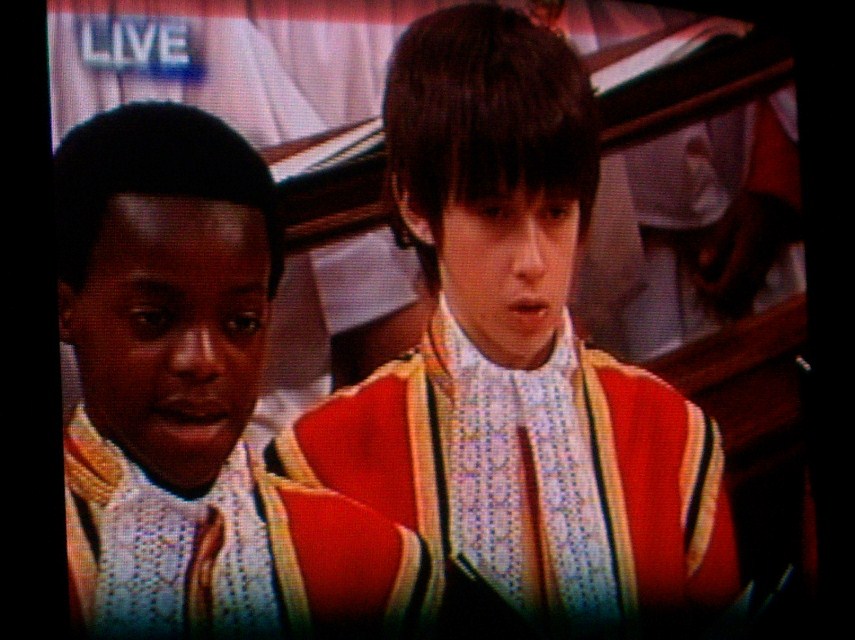
Westminster Abbey Boy's Choir. Assimilation, immigration, colonialism in the positive.
.
1.  On location.

London:  A City of vast history, remaining its own distinct entity, divided into several London Boroughs, rather than participating in an overall county system.  Counties and boroughs. Those apparently in the know say that parts of London may happen to be in a particular county geographically, it may be in another London borough economically. See http://www.englishforums.com/English/WhichCountyDoesLondonBelong/zjmjr/post.htm.  And a basic source, http://en.wikipedia.org/wiki/County_of_London

2.  An Event.  The Wedding.

London is, of course, the site of Royals.  Here is our update on London:  a look at old Mithraism showing there, the Telly and the Wedding, Immigration seen in Westminster Abbey, and Hats.  We sat with coffee, in bed, snapping pix.  Credits. Photos by This Commoner at the Telly, fair use of tiny snaps. Wavy lines by Telly people going up and down the screen probably to discourage home photos.  Undaunted, see here,
  • The Balcony Kiss. 
  • Topics at the wedding: 
    • Integration and immigration at the Boys' Choir,
    • Mithraism
    • The Telly and Changing mores (Elton John);
    • Institutional religion's compromises with Mithraism early on, leading to non-christian beliefs.
    • Hats.  These also attend the Wedding:  Royal, Wedding, Commoner, Clergy and Queen Victoria. 
 Then the rest of the wedding. Telly view of wedding.

I.  Events After Westminster

Best first. Nice cuppa, a little toast, a few pillows and enjoy. This, in case you could not tell, is a Commoner's home.


Snap, snap. Have to get between the sliding black line always going up, like a barrier at a wooden duck shoot at a carnival.

William, after.


Hats on the balcony.  Whose hat to the left? Camilla? Okay.  She's entitled.


And, before the momentous topics, see the couple on to live their lives, like the rest of us, but different.


II.  Real Life Observations at Westminster
.
Common global issue:  immigration, multinationalism, cultural identity, religious hold-overs that hold us all back.

Immigration. Assimilation, forced, encouraged, none.  Ethnic identity. Gains, losses for whom, what. 

Regular photos at section III.  As to multiethnicity,  England did it, at least for the course of the musical section of the wedding. Chorister choice.  Depends on voice and talent, as it should

The Boys' Choir.

Some 30 boys are in the Boys Choir at Westminster Abbey, see http://www.westminster-abbey.org/music/choir/ ; they attend the Choir School there, see http://www.westminster-abbey.org/choir-school.  There is also the adult male choir.  Ladies need not apply.


Can any country with a colonial past, or one that thinks itself superior to others, ever foster opportunity for others, while retaining the best of our heritage, and letting others do the same with theirs.  


Not assimilated.  

Women can and do teach and do other staff positions at the School, see sites and photos above. Typical selectivity under the guise of "history." So, it is indeed historical (hysterical?) that certain parts of anatomy are determinative -- more important to whether someone has opportunity to serve, than talent and smarts.


Yet the prevalence of ruffles suggests ambivalence. History crossed gender lines, but no on admits it.


Ruffles.

See FN 2; and an overview of Mithraism.  Was that among the first major religious system that excluded women from participation, that primary religion of Rome, old as 2800 BCE.  It appears that that element, among others of the old Roman State Religion, its militance, administrative skill, turf interest, was simply absorbed in order to get more converts for salesman Paul, regardless of its consistency with theology of the new Founder, whom Paul never knew.

Our traditions are more Paulian influenced Mithra, to woo Rome;  than Christian, so it would appear.

So there it probably is.  It appears that discrimination against women was not Jesus' idea, but was Paul compromising on theology with the Mithraists.  Anything to get a convert, even misrepresenting a founder and twisting into a new doctrine.


Faith restored:  Music of a different kind, to a different drummer. Welcome.


New York will permit them to marry now.  Either way.  Their choice.


Now:  Hats.  The Mitre.


 What do the ribbons on the clergy signify?  Curls?  Long hair?  What is the history of the mitre, the hat with two pointies.

These were Church of England clergy, but the two-horned mitre has a long history in the Roman Catholic church from which the protestants Sprang for various reasons.  See its pagan origins at http://www.onlinechurch.com.au/pagan-origins-of-catholicism-the-fish-hat-mitre-2  That site tracks the two-horned mitre to the priests of Dagon, fish god of the Philistines. See also http://www.tofm.org/papacy/pope_mitre.htm.  Of interest also are the vestiges of gnosticism, dualism that had been declared "heretic" because texts were interpreted other than the Roman orthodox wanted, see about horns of Mithra at http://www.gnosis.org/library/grs-mead/grsm_mythra.htm FN 1

Bride's hat:  veil.  Everyman's history is at http://www.veilubridal.com/history-bridal-veil.htm  The sites are commercial, so need to find a more historical view.

Bishop's hat:  Mitre from top view, all red inside. Now, that is weird and rather suggestive.


Other hats attract other kinds of attention.


Boaters will slide by, allowing attention to focus on the main event.  The danger of a snaky hat is that people will look at the hat and be more interested in it,  than in who you are. Which of Fergie's are you?


The Coach. To the Palace. William and Kate wedding

William about to step into the carriage.  Prince's hat, military.  Is that the Welsh Guard?


More royal hats.  And, in the Commoner's area, is that Queen Victoria?  It looks like a Queen Victoria crown.


III.  Westminster Abbey, The Rest of the Wedding

William and Kate. Surely we should not be on first name bases with royalty.  But it is more convenient than titles, when one has one and the other does not, yet. Duke and Duchess of Cambridge after, but before that, Prince William and Commoner Kate? 

Most self-explanatory -- 


William entering carriage, Westminster Abbey

Telly view.  Excellent.
.......................................


FN 1  Mitre and the Two-Horned Hat

Why do traditional churches keep women out, but wear their clothes. Keep the part of history that bolsters your own status, but forget the rest. Progress only on fronts that benefit.  Pass on the ruffles, for a religion founded by an anti-authoritarian itinerant pauper. Wealth.  Hoard it. Show it. Maybe we need that?

Do we?  We do know that the status of women in the Christian church, the traditional ones, is Outside.

Check your theological history.

This reflects, perhaps, Paul's need to placate the Mithra-ists of Rome, Mithraism as the State Religion before Christianization; and that took centuries.  In about 300-400 CE Christianity was adopted (Constantine as emperor 306-337 CE) and a tenet of Mithraism was no participation by women, and much secrecy. The bull (see the double horned hat here?) also featured. See http://mithra2004.tripod.com/Cult%20of%20Mithra.htm.  Click around for history, see also http://www.cais-soas.com/CAIS/Religions/iranian/Mithraism/mithraism_and_christianity.htm

See also Horns of Mithra, or other meaning, at Church of Saint Mary in Gdansk, Poland

Black Madonna, Horns of Mithra? Cathedral of St. Mary, Gdansk, Poland